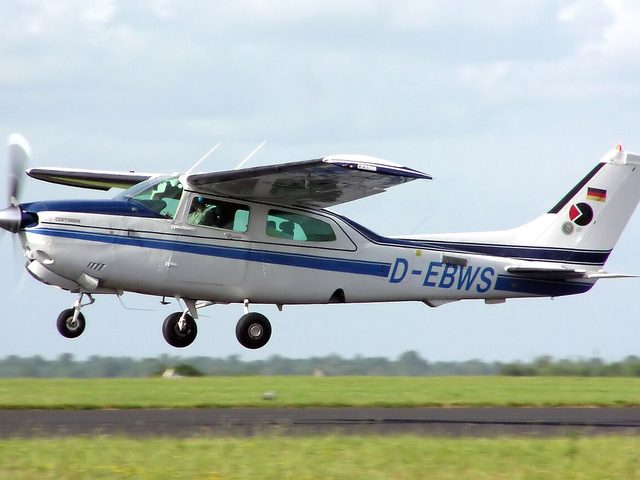
Cessna 210 Centurion
Single Piston· 2,744 globally registered
The Cessna 210 Centurion holds the distinction of being the first single-engine civilian aircraft with a retractable landing gear to achieve truly widespread success, combining the simplicity of a high-wing design with the performance of a complex airplane. Produced from 1960 to 1986, the 210 was Cessna's answer to pilots who wanted cabin-class comfort and cross-country speed without stepping up to a twin. Early models featured a strutted wing, but the 1967 cantilever redesign gave the Centurion its signature clean lines and a cruise speed approaching 200 knots, remarkable for a six-seat piston single. What made the 210 genuinely versatile was its combination of a roomy cabin, useful load around 1,400 pounds, and a service ceiling near 28,000 feet with turbocharging. It became a favorite for backcountry operators, aerial survey work, and serious cross-country travel, equally at home on a grass strip in Alaska or flying IFR coast-to-coast. The turbocharged variants, introduced in 1966, allowed owners to cruise in the flight levels and maintain speed over the Rockies, a capability few singles could match. Over 9,000 Centurions were built across dozens of variants, making it one of the most successful high-performance singles in aviation history. The 210's operating envelope reflects its mission: VNE of 200 knots, VNO of 174 knots, and a stall speed as low as 57 knots with full flaps. It's faster than a Bonanza in cruise, roomier than a Skylane, and more forgiving than a Mooney, though the gear system and fuel management demand respect. Decades after production ended, the Centurion remains a capable traveling machine with a loyal following. SkyMeter has tracked 874 flights across 326 airframes and 294 operators, with HZL HANGER LLC the largest observed operator.
Safety in context
The incident rate counts flights with ANY safety event detected by SkyMeter: go-arounds (a routine response, not a failure), unstable-approach gate flags (advisory thresholds), rejected takeoffs (the system working as designed), and runway events. It is NOT an accident rate or fatality rate. For accident statistics, refer to the NTSB Aviation Accident Database (USA) or the Aviation Safety Network. See methodology for what each event type measures.
Performance
Speed envelope & approach
Dimensions
Airframe geometry
Weight & identification
Operating limits
Top operators
By fleet size · last 7 days


Safety profile
Flagged flights · last 7 days
Recent incidents
Flagged flights of C210


Recent flights
Real flights of C210 · airborne ≥ 20 min


