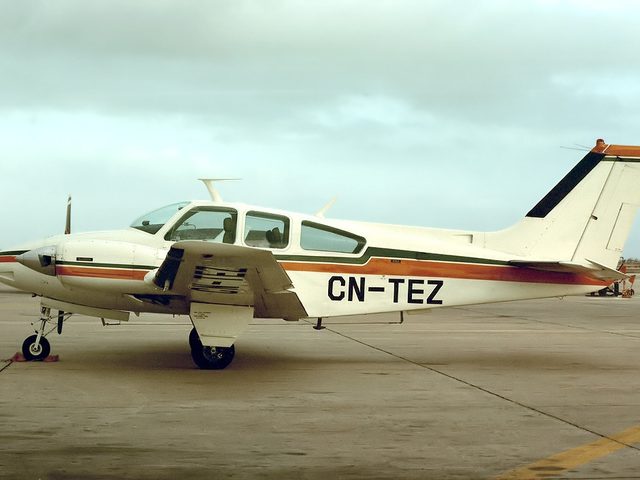
Beech Baron 55
Twin Piston· 1,561 globally registered
The Beechcraft Baron 55 is the foundational model of one of general aviation's most successful light twin families, first introduced in 1961 as a more powerful successor to the Travel Air. With its distinctive V-tail heritage (borrowed from the Bonanza lineage) replaced by a conventional tail for improved spin recovery, the Baron 55 established itself as the benchmark for owner-flown twin-engine aircraft. Powered by two Continental IO-470 engines producing 260 horsepower each, it offered private pilots and small charter operators a capable platform for instrument flight and light cargo work, with a useful load around 1,600 pounds and cruise speeds near 200 knots. The Baron's appeal lies in its combination of docile handling, rugged construction, and genuine redundancy, which is critical for pilots transitioning from singles or operating over challenging terrain. Its cabin seats four to six occupants in relative comfort, and the type became a staple of flight training schools teaching multi-engine ratings. Over six decades of production, Beechcraft refined the design through numerous variants (the 58, A55, B55, and others), but the original 55 remains recognizable for its straight tail, tip tanks, and understated elegance. The Baron earned a reputation for honest flight characteristics and manageable operating costs, though it demands respect during single-engine operations due to its relatively modest power-to-weight ratio. Today the Baron 55 serves a diverse mix of private owners, small charter operators, and flight schools across North America and beyond. Its longevity reflects Beechcraft's engineering discipline and the enduring demand for a twin that balances performance, safety, and maintainability. SkyMeter has tracked 588 flights across 225 airframes and 222 operators, with WING BIRD AVIATION LLC the largest observed operator.
Safety in context
The incident rate counts flights with ANY safety event detected by SkyMeter: go-arounds (a routine response, not a failure), unstable-approach gate flags (advisory thresholds), rejected takeoffs (the system working as designed), and runway events. It is NOT an accident rate or fatality rate. For accident statistics, refer to the NTSB Aviation Accident Database (USA) or the Aviation Safety Network. See methodology for what each event type measures.
Performance
Speed envelope & approach
Dimensions
Airframe geometry
Weight & identification
Operating limits
Top operators
By fleet size · last 7 days


Safety profile
Flagged flights · last 7 days
Family
Related variants
Recent incidents
Flagged flights of BE55


Recent flights
Real flights of BE55 · airborne ≥ 20 min


