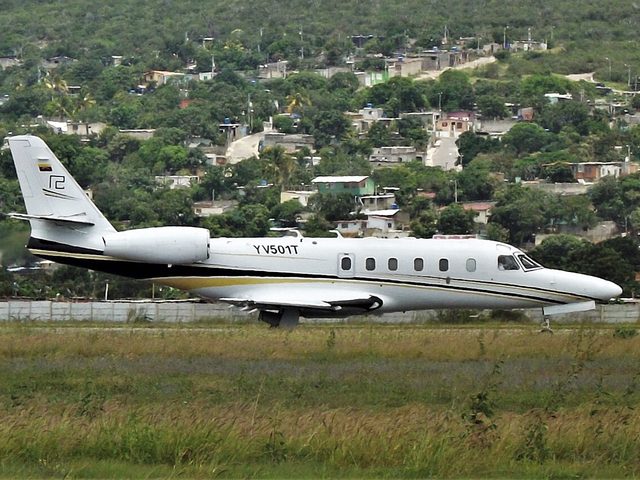
Iai Astra 1125
Twin Jet· 45 globally registered
The Israel Aerospace Industries Astra is a midsize business jet that carved out a distinctive niche as one of the most spacious cabin-class aircraft in its weight category when it entered service in 1986. Developed from the earlier Westwind lineage, the Astra featured a stand-up cabin with flat floor and six-foot headroom, unusual for a sub-25,000-pound aircraft, making it a favorite for corporate shuttle and air ambulance missions where passenger comfort and medical equipment access matter. The SPX variant introduced in the late 1990s brought improved Honeywell TFE731-40R engines, extended range to approximately 2,900 nautical miles, and upgraded avionics, cementing the type's reputation for transcontinental capability without stepping up to heavy-jet operating costs. The Astra's high-wing loading and relatively modest thrust-to-weight ratio give it a smooth ride in turbulence but require longer runways than some competitors, typically 5,000 feet for balanced field length at max weight. Its Mach 0.78 cruise and 45,000-foot ceiling are competitive with the Hawker 800 and Citation X family, though the Astra trades outright speed for cabin volume. The type found particular success in air ambulance and special-mission roles, where the wide fuselage accommodates stretchers and medical teams without the fuel burn of a Gulfstream or Challenger. Production ended in 2005 after approximately 200 airframes were built, but the fleet remains active in corporate and medical transport worldwide. The Astra's reputation for dispatch reliability and relatively low direct operating costs has kept residual values stable, and many operators have upgraded avionics to ADS-B and FANS standards to extend service life into the 2030s. SkyMeter has tracked 135 flights across 32 airframes and 23 operators, with 650584 Alberta Inc (Latitude Air Ambulance) the largest observed operator.
Safety in context
The incident rate counts flights with ANY safety event detected by SkyMeter: go-arounds (a routine response, not a failure), unstable-approach gate flags (advisory thresholds), rejected takeoffs (the system working as designed), and runway events. It is NOT an accident rate or fatality rate. For accident statistics, refer to the NTSB Aviation Accident Database (USA) or the Aviation Safety Network. See methodology for what each event type measures.
Performance
Speed envelope & approach
Dimensions
Airframe geometry
Weight & identification
Operating limits
Top operators
By fleet size · last 7 days


Safety profile
Flagged flights · last 7 days
Family
Related variants
No related variants.
Recent incidents
Flagged flights of ASTR


Recent flights
Real flights of ASTR · airborne ≥ 20 min

