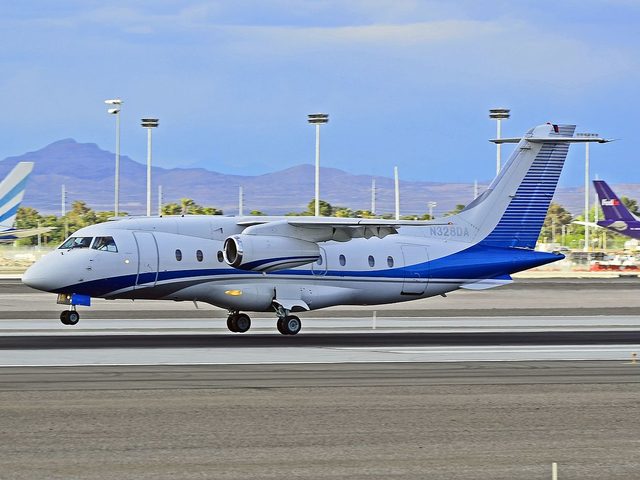
Dornier 328 Series
Twin Turboprop· 46 globally registered
The Dornier 328 is a German-built twin-turboprop regional airliner that carved out a niche in the 1990s as one of the fastest turboprops ever certified for passenger service. Developed by Dornier Luftfahrt and first flown in 1991, the 328 was designed to compete with 30-seat jets by offering jet-like cruise speeds, up to 620 km/h (335 knots), while retaining the fuel efficiency and short-field performance of a turboprop. Powered by Pratt & Whitney Canada PW119B engines driving six-blade Hartzell propellers, the aircraft could operate from runways as short as 1,100 meters and climb directly to FL310, making it ideal for mountainous terrain and underserved regional routes. What set the 328 apart was its pressurized cabin, stand-up headroom, and relatively quiet interior for a turboprop, features that helped it win orders from regional carriers across North America and Europe. Dornier also developed a jet variant, the 328JET, by replacing the turboprops with Pratt & Whitney Canada PW306 turbofans, though the original turboprop remained the more popular configuration. The type earned a reputation for ruggedness and reliability in challenging environments, from the Canadian Rockies to the Swiss Alps. Production ended in 2000 after Fairchild Dornier's financial troubles, with approximately 110 turboprop variants built. Today the 328 remains in service with regional and charter operators, particularly in North America, where its combination of speed, range (1,850 km), and STOL capability continues to make it a workhorse for remote and mountainous routes. The type's military variants (C-146A Wolfhound) serve the U.S. Air Force Special Operations Command for airborne ISR and light transport missions. SkyMeter has tracked 69 flights across 18 airframes and 2 operators, with Central Mountain Air Ltd the largest observed operator.
Safety in context
The incident rate counts flights with ANY safety event detected by SkyMeter: go-arounds (a routine response, not a failure), unstable-approach gate flags (advisory thresholds), rejected takeoffs (the system working as designed), and runway events. It is NOT an accident rate or fatality rate. For accident statistics, refer to the NTSB Aviation Accident Database (USA) or the Aviation Safety Network. See methodology for what each event type measures.
Performance
Speed envelope & approach
Dimensions
Airframe geometry
Weight & identification
Operating limits
Top operators
By fleet size · last 7 days

Safety profile
Flagged flights · last 7 days
Family
Related variants
No related variants.
Recent incidents
Flagged flights of D328


Recent flights
Real flights of D328 · airborne ≥ 20 min


