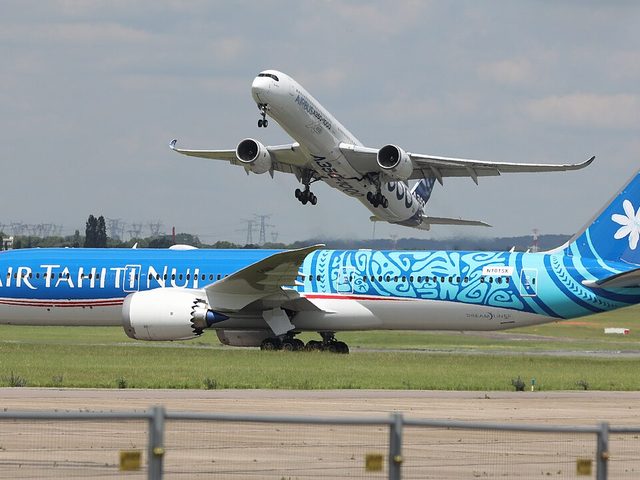
Boeing 787-9 Dreamliner
Twin Jet· 68 globally registered
The Boeing 787-9 Dreamliner represents the stretched middle variant of Boeing's revolutionary composite widebody family, introduced in 2014 as the successor to the baseline 787-8. With seating for 250-290 passengers and a range exceeding 7,600 nautical miles, the -9 became the most popular Dreamliner variant, combining transcontinental reach with the efficiency gains that made the 787 program famous. Its carbon-fiber composite airframe, comprising roughly 50 percent of the structure by weight, delivers a lighter, more fuel-efficient platform than traditional aluminum designs, while the advanced General Electric GEnx or Rolls-Royce Trent 1000 engines provide exceptional thrust-to-weight performance. The 787-9's operating envelope reflects its long-haul mission profile: a maximum operating speed of Mach 0.90 and 330 knots IAS, with a service ceiling of 43,000 feet that allows it to cruise above most weather and traffic. The type's approach speed of approximately 138 knots and relatively low stall speeds (Vs0 around 112 knots) give it excellent field performance for a heavy widebody, enabling operations at high-altitude airports and shorter runways that older widebodies cannot reliably serve. The aircraft's maximum takeoff weight of 557,000 pounds positions it squarely in ICAO's Heavy wake turbulence category, yet it burns roughly 20 percent less fuel per seat-mile than the 767s and 777-200s it often replaces. Beyond raw performance, the 787-9 introduced passenger-focused innovations that redefined long-haul comfort: larger windows with electrochromic dimming, higher cabin humidity enabled by the corrosion-resistant composite structure, and a lower cabin altitude (6,000 feet equivalent versus the typical 8,000 feet) that reduces fatigue on ultra-long sectors. Airlines quickly embraced the type for opening new city pairs that were previously uneconomical, with routes like Perth to London and Auckland to Chicago becoming viable for the first time. The -9's blend of range, capacity, and efficiency made it the backbone of many carriers' long-haul fleets, from legacy majors to Gulf carriers expanding their global networks. SkyMeter has tracked 7,775 flights across 718 airframes and 21 operators flying distinct routes, with Air Canada the largest observed operator.
Safety in context
The incident rate counts flights with ANY safety event detected by SkyMeter: go-arounds (a routine response, not a failure), unstable-approach gate flags (advisory thresholds), rejected takeoffs (the system working as designed), and runway events. It is NOT an accident rate or fatality rate. For accident statistics, refer to the NTSB Aviation Accident Database (USA) or the Aviation Safety Network. See methodology for what each event type measures.
Performance
Speed envelope & approach
Dimensions
Airframe geometry
Weight & identification
Operating limits
Top operators
By fleet size · last 7 days


Safety profile
Flagged flights · last 7 days
Family
Related variants
Recent incidents
Flagged flights of B789


Recent flights
Real flights of B789 · airborne ≥ 20 min


