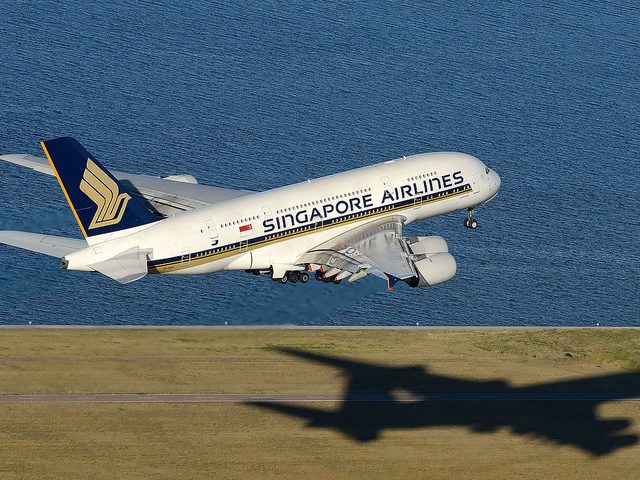
Airbus A380-800
Quad Jet
The Airbus A380 is the world's largest passenger airliner and the only commercial aircraft assigned ICAO wake turbulence category J: super heavy. First flown in 2005 and entering service with Singapore Airlines in 2007, the double-deck widebody was designed to challenge Boeing's monopoly on very large aircraft and serve high-density long-haul routes. With a maximum takeoff weight exceeding 1.2 million pounds and typical configurations seating 525 passengers across two full-length decks, the A380 represented a bold bet that hub-and-spoke traffic would continue to grow. Its four Engine Alliance GP7200 or Rolls-Royce Trent 900 turbofans deliver a range of 8,000 nautical miles, while the sheer size demands purpose-built gates and reinforced taxiways at the airports that can handle it. The A380 holds several distinctions: it's the first airliner with a take-off weight above 500 tonnes, the quietest widebody per seat-mile, and the only jetliner to routinely operate with more than 500 passengers. Its operating envelope includes a maximum cruising altitude of 43,000 feet and a long-range cruise speed of Mach 0.85, though it sacrifices some efficiency for passenger comfort and space. Despite its engineering achievement, the A380 program struggled commercially. Airlines increasingly favored fuel-efficient twin-engine widebodies like the 787 and A350 for point-to-point routes over the hub-filling strategy the A380 required. Airbus delivered the final A380 in 2021 after just 251 aircraft, with Emirates operating more than half the fleet. The type remains in service on prestige long-haul routes where its unmatched capacity and passenger experience justify the operational complexity. SkyMeter has tracked 1,428 flights across 152 airframes and 2 operators over routes, with QANTAS AIRWAYS LIMITED the largest observed operator.
Safety in context
The incident rate counts flights with ANY safety event detected by SkyMeter: go-arounds (a routine response, not a failure), unstable-approach gate flags (advisory thresholds), rejected takeoffs (the system working as designed), and runway events. It is NOT an accident rate or fatality rate. For accident statistics, refer to the NTSB Aviation Accident Database (USA) or the Aviation Safety Network. See methodology for what each event type measures.
Performance
Speed envelope & approach
Dimensions
Airframe geometry
Weight & identification
Operating limits
Top operators
By fleet size · last 7 days

Safety profile
Flagged flights · last 7 days
Family
Related variants
No related variants.
Recent incidents
Flagged flights of A388

Recent flights
Real flights of A388 · airborne ≥ 20 min


