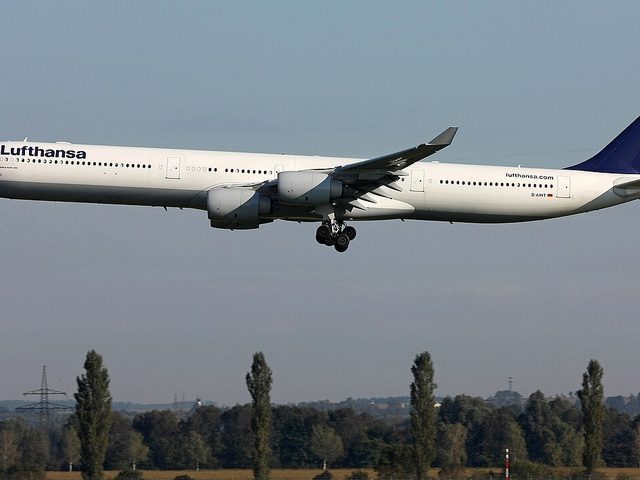
Airbus A340-600
Quad Jet
The Airbus A340-600 holds the distinction of being the longest commercial airliner ever built at 75.36 meters, stretching even beyond the Boeing 747-8 by nearly a meter. Launched in 1997 and entering service with Virgin Atlantic in 2002, the A346 was Airbus's answer to ultra-long-haul routes that required both range and passenger capacity without the operational restrictions that limited twin-engine ETOPS operations at the time. Its four Rolls-Royce Trent 500 engines could push the aircraft to ranges exceeding 7,800 nautical miles, making nonstop flights like Los Angeles to Melbourne or New York to Hong Kong economically viable in the early 2000s. The type became particularly popular with Lufthansa, which operated the largest fleet, and with Middle Eastern carriers seeking prestige flagships. However, the A340-600's reign was short-lived. The advent of liberalized ETOPS regulations allowing twins like the Boeing 777-300ER and Airbus A350 to fly the same routes with significantly lower fuel burn rendered the four-engine configuration commercially obsolete. By the mid-2010s, airlines began retiring their A346 fleets en masse, with many frames finding second lives as VIP transports or heading to desert storage. The type's operational ceiling of 41,450 feet and maximum cruise speed of Mach 0.86 were respectable but not exceptional, and its fuel consumption (roughly 35 percent higher than competing twins) sealed its fate in an era of rising fuel costs and environmental scrutiny. Today, the A340-600 survives primarily in government and charter service, a reminder of the brief period when four engines were still considered necessary for the world's longest routes. SkyMeter has tracked 80 flights across 12 airframes and 1 operators, covering distinct routes.
Safety in context
The incident rate counts flights with ANY safety event detected by SkyMeter: go-arounds (a routine response, not a failure), unstable-approach gate flags (advisory thresholds), rejected takeoffs (the system working as designed), and runway events. It is NOT an accident rate or fatality rate. For accident statistics, refer to the NTSB Aviation Accident Database (USA) or the Aviation Safety Network. See methodology for what each event type measures.
Performance
Speed envelope & approach
Dimensions
Airframe geometry
Weight & identification
Operating limits
Top operators
By fleet size · last 7 days
No operator data available.
Safety profile
Flagged flights · last 7 days
Family
Related variants
Recent incidents
Flagged flights of A346


Recent flights
Real flights of A346 · airborne ≥ 20 min


